
Bethlem Gallery on why co-production needs to stay at the forefront – and one way it is core to our work
What is co-production? Simply put, it is a term for collaborative processes that actively involve people who are stakeholders in whatever is being created, developed or delivered. It’s rarely simple to achieve in practice, however. Used across public services and the cultural sector, co-production is participation that goes beyond consultation.
Co-production done well is about embedding processes that genuinely support shared decision-making and valuing different forms of knowledge and expertise. It recognises the importance of lived experience alongside community and professional expertise and ensures that a diverse range of perspectives meaningfully contribute to shaping goals, content and methods that inform the development and design of whatever is being produced. In the context of co-production, the slogan that originated from the disability rights movement ‘nothing about us without us’ can be extended to become ‘nothing for us without us’.
The landscape around co-production is challenging. An organisation really pushing participatory practice in the USA – OF/BY/ALL (which Arts Council England links to for advice on its former investment principles (https://www.artscouncil.org.uk/blog/essential-read-inclusivity-relevance) – had to close in 2024 due to a sharp drop in American organisations able to prioritise inclusive practices. In their statement, they argue that ‘For many, creating more equitable and inclusive working partnerships and processes turned into an optional daydream instead of a critical reality… In a hostile world, offering care and building community are revolutionary acts. Keep doing it’ (https://www.ofbyforall.org/).
In the UK, Arts Council England (ACE) seems to have put co-production on the back burner in its new interim strategy – although it is still heavily implicated in the DCMS objectives around agency, engagement and creative diversity that ACE refers to. At Bethlem Gallery, we recognise that co-production is a resource-heavy process and strategy – but we hope that consensus remains among the UK arts sector that this does not make it any less vital to strive for.
Art in hospital spaces
Since 2020, including and beyond its own spaces, Bethlem Gallery has led on the Art Strategy for the South London and Maudsley NHS Foundation Trust. The gallery team does this with co-production at the heart of it. We aim to work long-term and in collaboration with artists with lived experience and stakeholders on commissions, projects, exhibitions and programming.
When our team talks about our ‘Art Strategy’, it is a blanket term title for a strand of work to implement an arts programme across Trust sites, underpinned by participation and engagement with service users, staff and stakeholders. It includes site-specific commissions, artist residencies and creative research programmes to improve the hospital environment and experience – proven in many studies to improve patient recovery, patient and staff morale and experience. [References below].
There are no negatives to having co-produced artwork in a building, where service users, carers and staff have been involved in every stage of development. Throughout each process, my colleagues have used creative approaches to navigate conversations that range from the themes, colours, and the emotional qualities needed in the space, to the practical realities of health and safety and engagement considerations within clinical settings, ensuring that both creative aspirations and everyday needs are considered.
The new Pears Maudsley Centre for Children and Young People (PMCYP), for example, will open fully in 2027. While work continues, we are delighted it has opened its doors with new projects ‘Peer Support’ by visual artist Marcus Coates and ‘From Root to Form’ by artist/researcher Sarah Lloyd.
The art commissions for this building have been shaped by a group of young people who thoughtfully and uncompromisingly took the lead in developing artist briefs (through a series of creative workshops facilitated by artists) interviewing artists, and selecting the commissions. The young people’s choices reflect the perspectives, experiences, and futures they wanted to see represented in the building
At every stage of the process for each artwork, they input their ideas and views. Staff and carers worked hard to make it happen. When they are all installed, we hope the people visiting and using the space will agree that the coproduced integrated art makes a huge difference to being in that space.
Kate Watson is currently running Bethlem Gallery’s art strategy, producing artworks that have been years in the making at PMCYP – and also working on projects such as the research approach to new artworks for the National Autism Unit, where a series of interventions and collaborations with artists, as well as organisations and activists concerned with neurodiversity, have explored how sensory arts practices can contribute to understanding the experiences of autistic and neurodiverse people and inform the design of more accessible and inclusive healthcare environments.
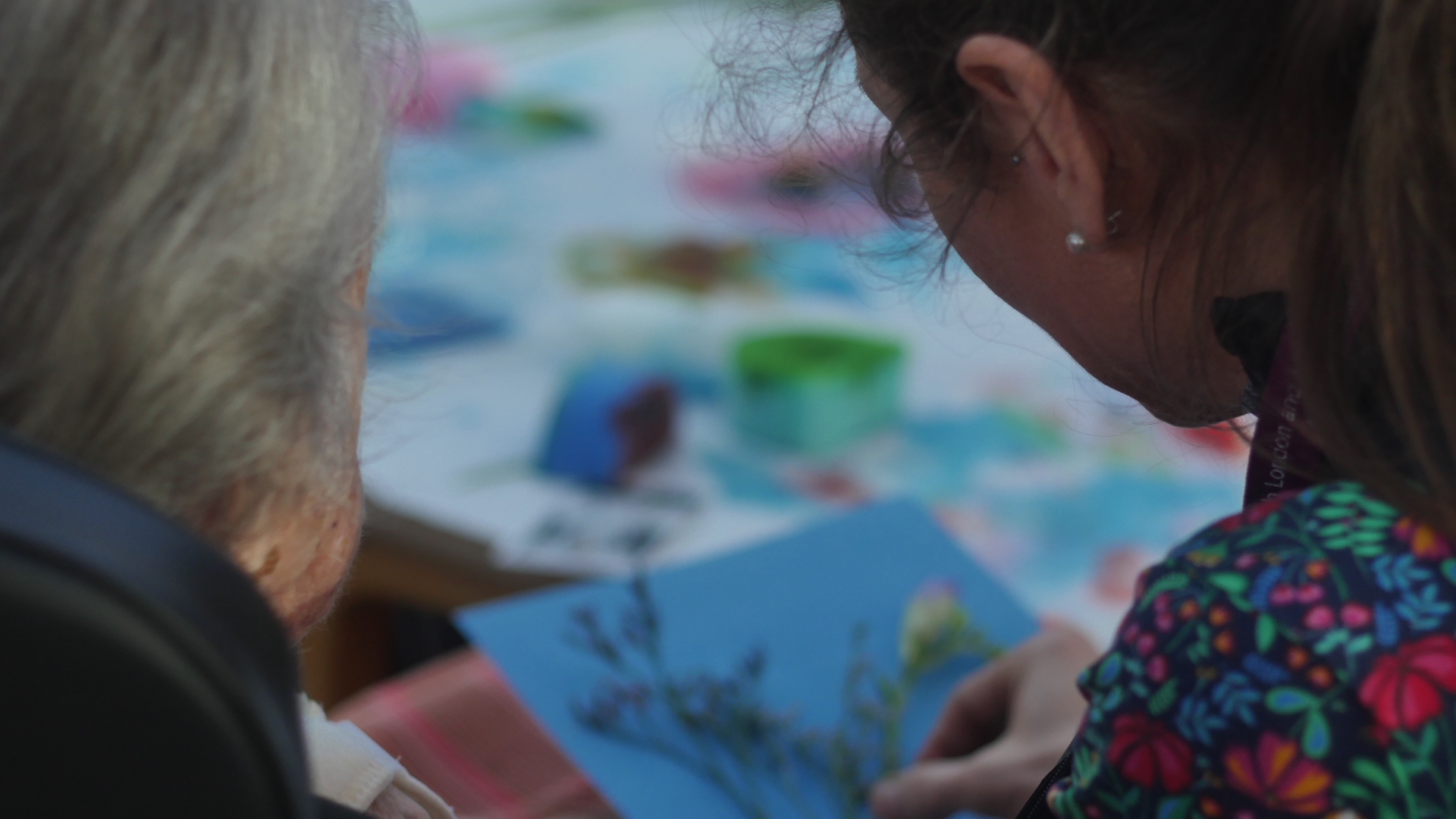
We’ve also just completed a project to develop artworks with the Greenvale Specialist Care Unit for people living with dementia and complex mental health needs. Artist Lucy Steggals worked responsively with residents, staff and families/carers to develop a set of interactive toolkits aimed at encouraging sensory interaction between families/carers, staff and Greenvale residents, expanding the understanding of art strategies as ‘art on walls’.
Co-producing artworks for hospital spaces is much more than art on walls – it’s changing spaces for the better to support everyone’s experience inside them – to help us all feel and think differently, to provide a means to build connections with others in the space – together.
Please stay tuned over the next month when we will be posting further details of our current and upcoming projects that feature as part of our art strategy.
If you would like to get in touch with a member of the Bethlem Gallery team, please email info@bethlemgallery.com.
References:
https://www.artsy.net/article/artsy-editorial-hospital-art-helps-people-heal-artworks-care
https://www.who.int/europe/publications/i/item/9789289054553