
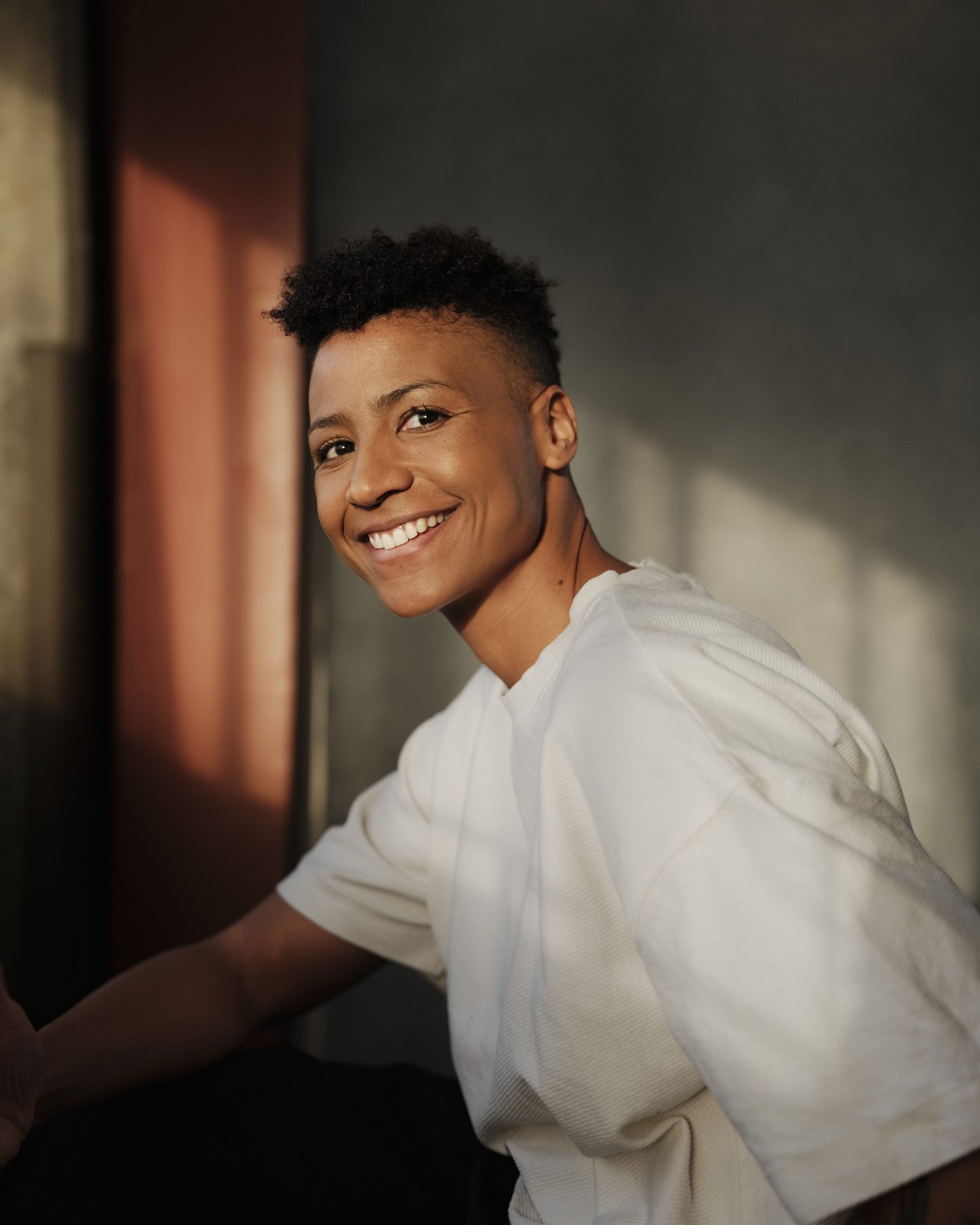

Interview with Exhibition Poet Jess Murrain
This week, Curator Karim Sultan (KS) invites actor, writer and poet Jess Murrain (JM) to discuss her responses to Bethlem Gallery’s latest exhibition, The Places We Know.
KS: What does it mean for you to be an “exhibition poet”?
JM: It feels very meaningful to be asked to be an exhibition poet…. It takes a whole body of people to create a writing practice…That said, the writer’s experience is quite solitary. Bethlem Gallery is such a dedicated and inclusive space…It’s unique… the feeling of inclusivity runs through every element. It’s not just something written on a website. I feel part of something that’s both powerful and empowering. It’s incredibly enriching.
KS: Can you tell us your process for developing poetic responses to the artworks?
JM: For me, there are loads of threads when writing in response to another artwork…. It’s surprising……You’re looking deeper in relation to another artist’s work. There is a different dialogue, and there is a responsibility to it.
My process grows when I am not just in my head, in front of a blank space…I often work with sound and across media…Usually, I spend time with artworks… I look at form, colour, visual presentation… I think about narrative and what the artist must have been experiencing… And what they are trying to do. It excites me that an artwork is not just one moment in time.
I reflect before I start writing. I go with my instinct as much as possible. It might conjure a story, or I might feel inspired to experiment on the page… I ask: How can I instinctively get to my voice?
I don’t gate-keep my experience. It’s like cooking a nice meal….you need to spend time with the ingredients… Without a recipe, you’re tasting as you go along.
What’s harder is when I don’t connect immediately to an artwork. We don’t always know consciously why this is. It might not bring connection, but I might be drawn to… the tools, materials, and deconstructing the artwork… In terms of music, this might be like listening to a bassline closely even if I’m not drawn to the overall track. It’s important to listen deeply to all levels and layers of an artwork and even if I’m not immediately drawn to it, I can always find it’s ‘hook’. When writing from artworks, I don’t stop interrogating a piece until I’ve found something I connect to. I also find it useful to go down tangents, like tentacles… It might remind me of something else, that reminds me of something else…Using the brain’s imaginative associations and resources with a series of threads to follow. This is why art is so powerful.
KS: Are there any works that stood out to you, either as a viewer or when developing a response?
JM: I was very taken by Pat Mears’s ‘Light as Landscape’ , it draws me in; it’s incredibly powerful. I’m interested in the etching technique. Like a Tardis, it feels small in scale but huge feeling and very profound for me. Feathers offer this sense of deep possibilities.
Imma’s work I also found striking… It felt like the work held a huge amount of history. It felt somehow otherworldly… This jumped out to me, striking a chord. Not quite sure why…the monochrome face has a haunting power to it.
The complexity drew me into Sue Morgan’s work… Like poetry, when there are limits to language to describe human complexity, abstraction can offer expanse. It felt scientific and, at the same time, dynamic… I started to think about constraint and freedom. Thinking formally about structure…an architectural shape on the page. I often think of poems as paintings… and ask myself, how can I be playful with how I arrange this on the page. My response to this artwork was slow burning and thoughtful at first, and then it became quite a visceral one.
Daniel Regan’s subject matter… There is great bravery around it. Self-harm is not often talked about with such tenderness. I was struck by the sense of movement and process to these works…capturing moving image to externalise internal emotion. This encouraged a sense of self-enquiry… What this subject means to me autobiographically. I can abstractly explore this. And therefore, it feels safe. At the same time, I’m grateful to the artist for this work. It stirred up a personal reflection and personal dialogue. And perhaps that’s in some way the antidote the shame around this subject? Discussion, dialogue and ultimately compassion with one-self.
KS: As a writer, what is important about looking at the work of another artist? And how can encountering visual art challenge or enrich the work of a writer?
JM: There is something about remaining open and interested. As someone who is used to writing on my own, an artwork is a way to feel inspired. It’s a point of entry, which is hard for writers sometimes… Especially with poetry. Infinite possibilities can lead to a sense of feeling frozen. But here you’re in conversation with an artist, which is a real privilege.
A poet is a deep listener… looking, hearing, and feeling in profound, thoughtful, sensitive ways is in essence poetry practise. It encourages you to think about the major and the minor, different voices, different questions that aren’t ordinarily immediately surfaced. For a writer to expand their boundaries is essential- to transcend what they believe is possible and in a way surprise themselves- break their own rhythm with a sense of awe and wonder… And this is where looking at other artworks and being in dialogue with other artists as a writer is so special. It is the biggest catalyst for your imagination and a sense playfulness, which is important to me.
Jess is working closely with Bethlem Gallery artists for the duration of the show and beyond. A closing event with Jess and artist Halimah Zakiuddin is planned for Wednesday 8 April at 1.30pm, to coincide with the final week of the exhibition.